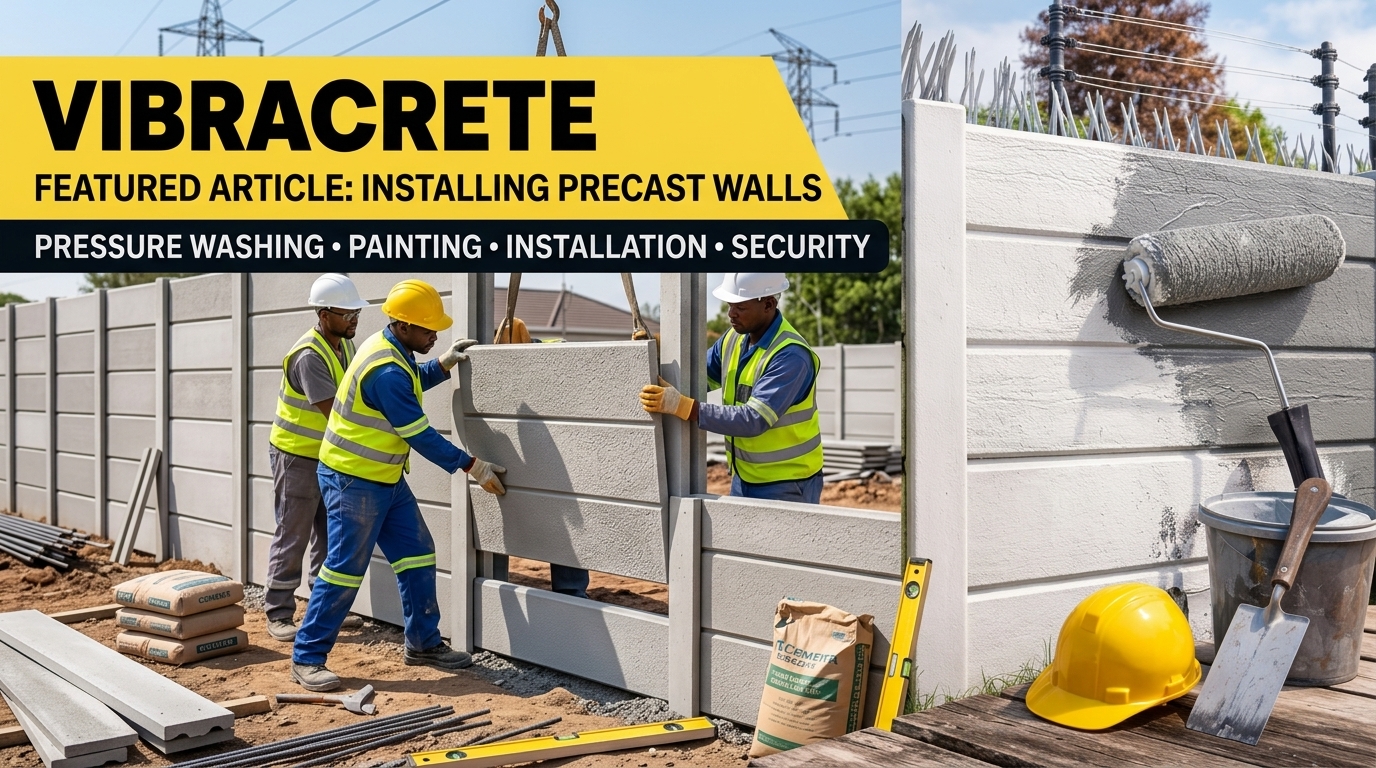
Vibracrete is everywhere because it solves a very specific South African problem: we need boundaries, we need them fairly quickly, and we need them at a price that doesn’t require a second bond. But while vibracrete is common, good information about it isn’t. Most of what you’ll find online is scattered across forums, WhatsApp groups, or short supplier blurbs that skip the details homeowners actually care about. This article pulls everything together in one place — from buying and cleaning vibracrete, to painting it properly, installing it straight, understanding local regulations, and adding security like spikes or electric fencing. You don’t need to read the whole thing in one go. If you’re just here to figure out painting, you’ll find that section works on its own. Same with installation, pricing, or security. Let’s start at the beginning, because almost every vibracrete project follows the same basic path — whether people realise it or not. What Vibracrete Actually Is (and Why Quality Varies So Much) Vibracrete is precast concrete fencing made in moulds, vibrated to remove air bubbles (hence the name), then cured before being installed into concrete posts. On paper, it sounds straightforward. In practice, not all vibracrete is created equal. Some manufacturers use better cement ratios, better aggregate, and take curing seriously. Others cut corners. From the outside, two slabs might look identical when new, but five years later one is still solid and the other is cracked, chipped, or soft at the edges. Longevity depends on several real-world factors, not marketing claims: In Cape Town’s coastal climate, this matters even more. Salt air, wind, and winter rain will exploit any weakness over time. Vibracrete isn’t fragile by default, but it is unforgiving when installed badly or neglected. Understanding this upfront helps you make better decisions later — especially when choosing between new, second-hand, or patterned slabs. Buying Vibracrete: New vs Second-Hand (and What to Look Out For) For many homeowners, the buying decision comes down to budget first, aesthetics second. That’s understandable, because vibracrete is popular largely because it’s cost-effective. In Cape Town and surrounding areas: Second-hand vibracrete can make sense if: However, you need to inspect slabs carefully. Look for: One or two imperfect slabs aren’t the end of the world, but structural cracks near the post edges can shorten the lifespan dramatically. Pattern vibracrete deserves a special mention. These slabs are often thicker because of additional layers and textures. They come in different designs and sometimes even colours, but in Cape Town they’re relatively rare and attract a premium. Once the cost per slab climbs high enough, many homeowners realise that a traditional brick or block wall starts to make financial sense instead — especially if they’re planning to plaster and paint anyway. Regulations in Cape Town and South Africa: How High Can Vibracrete Be? Before anyone starts digging holes or stacking slabs, it’s worth understanding the legal side. Vibracrete may feel informal because it’s so common, but it still falls under municipal regulations. In Cape Town and most of South Africa: The exact rules can vary slightly by municipality and zoning, but vibracrete is often one of the more flexible boundary options. That’s one reason it’s so popular for upgrades — you can extend an existing wall upwards without demolishing everything. Still, if you’re going significantly higher or adding electric fencing, it’s worth double-checking local by-laws or asking your installer. It’s far easier to confirm upfront than to deal with complaints or forced alterations later. Refer to The City of Cape Town’s website for more info. Installation: Why Straight and Level Matters More Than People Think Installation is where many vibracrete walls fail — not immediately, but slowly, over years. A properly installed vibracrete wall starts with straight, well-aligned posts set into solid concrete footings. If posts are slightly out of level, the slabs will carry uneven load. Over time, this leads to cracking, leaning, or gaps opening between slabs. This matters even more if: Vibracrete is surprisingly strong when forces are distributed evenly. When they’re not, the concrete doesn’t bend — it cracks. This is also why vibracrete costs roughly one-third to one-quarter the cost of a brick wall in labour and materials. It’s quicker to install, requires fewer skills, and uses fewer materials. But that speed advantage disappears if corners are cut. A good installer will: A bad installer will stack slabs quickly and hope for the best. How do I Clean Vibracrete: The Hardest Step (and the Most Skipped) Almost everyone underestimates how difficult vibracrete can be to clean — especially old slabs. Over time, vibracrete collects: For paint to last, the surface must be clean. Unfortunately, vibracrete’s porous texture makes this harder than it looks. In many cases, cleaning requires: Some slabs clean up easily. Others fight back. If paint is applied over dirt, algae, or loose material, it will fail — often within a year or two. This is why painting vibracrete is less about the paint itself and more about preparation. Which brings us to the most misunderstood topic of all. Can I use Roof Paint to Paint Vibracrete? In South Africa, many people use roof paint on vibracrete — and surprisingly, it often works well. Roof paint is: However, roof paint isn’t magic. It only performs well if the surface underneath is properly prepared. For best results: Skipping prep is the main reason painted vibracrete starts peeling or fading unevenly. When done properly, painting can significantly extend the lifespan of vibracrete by sealing the surface and reducing moisture penetration. Painted vibracrete also tends to age more gracefully. Instead of patchy grey and dark stains, it fades more uniformly and is easier to touch up later. Extending Vibracrete Upwards: What Actually Works Long-Term One of vibracrete’s biggest advantages is how easy it is to extend upwards. Existing posts can often accommodate additional slabs, or extensions can be added. That said, height increases load and wind resistance. The taller the wall, the more critical: Extending vibracrete is usually more cost-effective than rebuilding, but only if the original structure is sound. Adding height to